
Table of Contents
- AFCI vs GFCI Breaker Requirements for Marina del Rey Homeowners
- The Two Core Protection Technologies: AFCI and GFCI
- Comparing AFCI and GFCI Protection Features
- Budgeting for AFCI and GFCI Breaker Upgrades
- Selecting the Right Breaker for Your Electrical Safety Upgrade
- Next Steps for Marina del Rey Electrical Safety
AFCI vs GFCI Breaker Requirements for Marina del Rey Homeowners
Marina del Rey homeowners planning a kitchen remodel must now navigate the updated AFCI vs GFCI breaker requirements that take effect under the 2026 California Electrical Code. According to Marina del Rey’s Trusted Local Electricians, the code expansion mandates additional arc-fault and ground-fault protection for circuits serving kitchen areas, making it critical to understand the differences between the two types of breakers to ensure compliance and household safety.
In the greater Los Angeles area, enforcement varies by jurisdiction. While the City of Los Angeles adopted the 2026 CEC on January 1, 2026, unincorporated communities such as Marina del Rey follow Los Angeles County regulations, which incorporate the same expanded safety standards. Homeowners undertaking kitchen remodels that involve panel upgrades or adding new circuits must typically obtain permits and schedule two required inspections: a rough-in inspection and a final inspection, to verify that the electrical work meets current code.
This article provides a clear comparison of AFCI and GFCI breaker requirements specifically for Marina del Rey residences, helping property owners make informed decisions. Understanding the distinct roles of Arc Fault Circuit Interrupters (AFCIs) and Ground Fault Circuit Interrupters (GFCIs) is essential for ensuring your home meets current safety standards.
The Two Core Protection Technologies: AFCI and GFCI
AFCIs detect dangerous electrical arcs that can ignite fires, while GFCIs protect people from severe electric shocks by identifying current leakage.
AFCIs are required for all 120-volt, single-phase, 15- and 20-ampere branch circuits serving kitchens, among other residential areas. Standard code provisions recognize combination-type AFCIs as the primary devices for meeting this requirement. When supplemental arc-protection circuit breakers are installed, the first outlet box must be marked to indicate the type of AFCI protection provided. The maximum wiring length between the overcurrent device and the first AFCI-protected outlet is limited to 50 feet for 14 AWG conductors and 70 feet for 12 AWG conductors. Additionally, an exemption exists for individual branch circuits that supply fire alarm systems, provided they are installed in approved metal raceways or metal-clad cables.
Ground-fault circuit interrupters (GFCIs) operate by continuously comparing the current flowing on the hot and neutral conductors. A difference as small as 4 to 6 milliamperes—indicating current leakage to ground through a person—causes the device to trip and shut off power within a fraction of a second. As noted by Marina del Rey Top Electricians, the 2026 California Electrical Code, effective for City of Los Angeles projects on January 1, 2026, has expanded GFCI requirements significantly for kitchen remodels. This expansion now covers all countertop receptacles, receptacles within 6 feet of a sink, and circuits serving dishwashers and garbage disposals, ensuring comprehensive shock protection where water and electricity may come into contact. Understanding the distinct role and code requirements of each device provides the foundation for a side-by-side comparison of their feature sets and installation nuances.
Comparing AFCI and GFCI Protection Features
Having introduced the two primary protection technologies, this section compares their features, code-required areas, installation configurations, nuisance-tripping concerns, and dual-function options in the Colorado Residential Code 2021.
| Feature | AFCI Breaker | GFCI Breaker | Dual Function AFCI/GFCI |
|---|---|---|---|
| Protection Type | Detects dangerous arcs | Detects ground faults by sensing hot-to-neutral imbalance | Provides both detections |
| Hazard Addressed | Reduces fire risk from arcing | Prevents electrocution from leakage | Addresses both fire and shock hazards |
| Areas Required | In finished living areas such as kitchens and bedrooms per Colorado Residential Code 2021 | Outlets in basements, bathrooms, kitchens, garages, and outdoors | Meets both AFCI and GFCI area requirements |
| Installation Configuration | Breaker in the main electrical panel | Breaker in panel or receptacle at the first outlet | Single breaker in the main panel providing both functions |
| Nuisance Tripping Concerns | Older units tripped on motor loads; modern units reduced sensitivity | Trips at small leakage thresholds (around 5–6 mA); sensitive to ground-leak conditions | Combined tripping tendencies; may increase nuisance events |
| Code Marking and Length Limits | Supplemental devices require marking the first outlet box; 50 ft limit for 14 AWG conductors | No equivalent marking or length limits for GFCI receptacles | AFCI marking and length limits apply |
| Recommended Approach | Dedicated AFCI breakers for circuits in finished living spaces | GFCI breakers or receptacles for circuits in basements, bathrooms, kitchens, and outdoors | Common recommendation: pair a dedicated AFCI breaker with a GFCI outlet for easier troubleshooting and replacement |
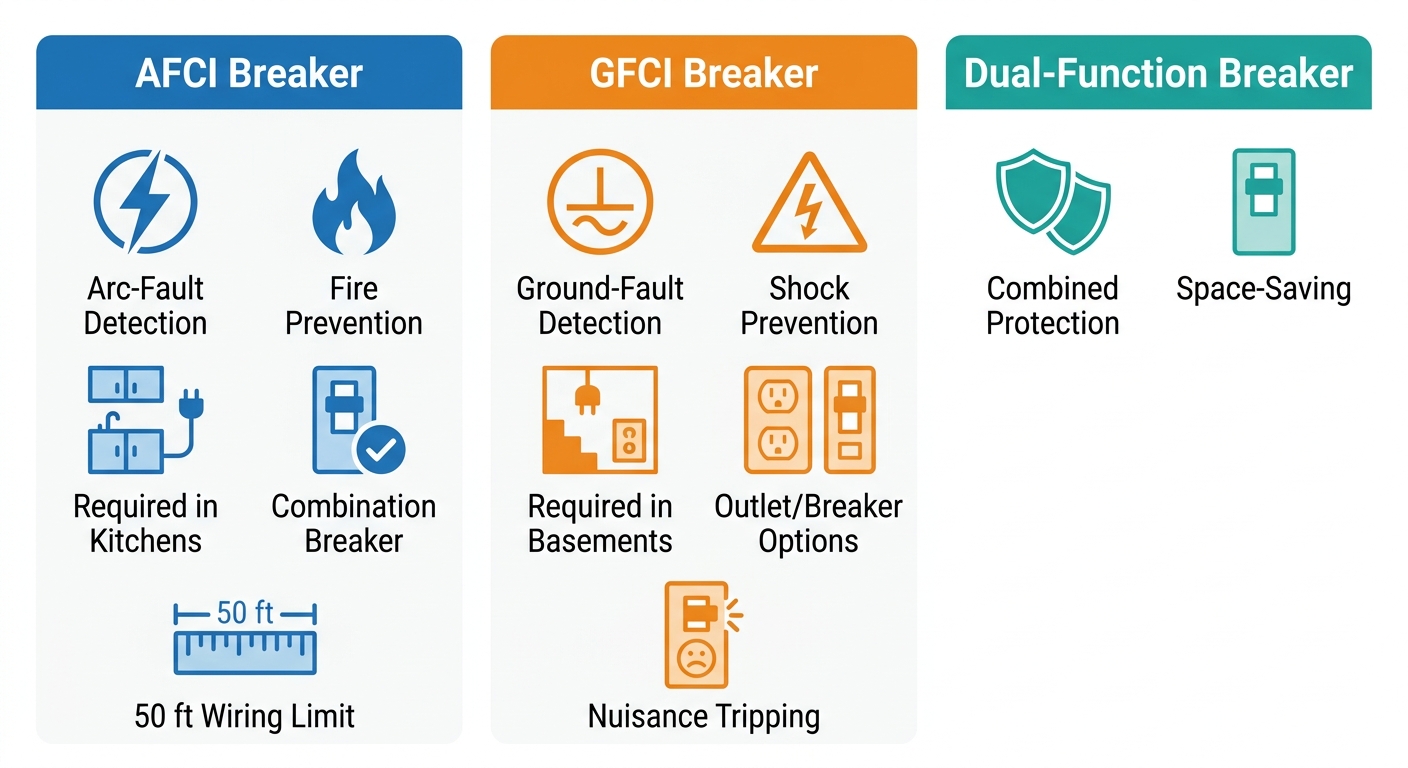
The feature differences outlined here influence the selection of protection devices and the planning of breaker upgrades.
Budgeting for AFCI and GFCI Breaker Upgrades
After evaluating the protective benefits of AFCI and GFCI technology, homeowners naturally move from comparing features to financial planning. The total budget for bringing a property up to the latest safety standards depends on a few key variables, all of which are best assessed through a custom quote from a licensed electrician.
The number of breakers required is the most direct cost driver. The 2026 California Electrical Code, which became effective in the City of Los Angeles on January 1, 2026, expands AFCI and GFCI protection to additional circuits during kitchen remodels and other renovations. As noted by Marina del Rey Top Electricians, a larger home or a more complex panel layout will require more devices, directly influencing the material total.
Most significant electrical work—especially panel upgrades or new circuits—requires municipal permits and a two-stage inspection process consisting of a rough-in and a final inspection. Marina del Rey Top Electricians explains that these fees apply regardless of the breaker count, and enforcement standards can vary among the City of Los Angeles, Los Angeles County, and independent cities like Santa Monica.
With a clear picture of what drives the cost, the next step is selecting the specific breakers that satisfy both the safety requirements and the budget. A professional assessment from a licensed electrician will produce an accurate estimate that accounts for the property’s layout and the local jurisdiction.
Selecting the Right Breaker for Your Electrical Safety Upgrade
In Marina del Rey, homeowners must weigh the roles of arc-fault circuit interrupters (AFCIs), ground-fault circuit interrupters (GFCIs), and dual function AFCI/GFCI circuit breakers to meet both code obligations and protection expectations.
AFCIs are designed to detect hazardous electrical arcs that can ignite fires, while GFCIs interrupt power when current leaks to ground, reducing the risk of electric shock. Dual-function breakers combine both protections in a single device for areas where both arc and ground-fault hazards are present.
- Combination-type AFCI breakers are required by the National Electrical Code for 120-volt, 15- and 20-ampere branch circuits in bedrooms, kitchens, living rooms, and similar residential spaces.
- When a supplemental arc-protection circuit breaker is used on a branch feeder, the first outlet box in the circuit must be labeled to indicate AFCI protection, as outlined in model residential electrical codes.
- For 14 AWG conductors, branch wiring between the overcurrent device and the first outlet must not exceed 50 feet to remain within AFCI protection limits; the maximum length increases to 70 feet when 12 AWG wire is installed.
Because state and local jurisdictions frequently adopt amendments that modify national requirements, residents in Marina del Rey, Santa Monica, and nearby California communities benefit from reviewing regional electrical codes or seeking guidance from a licensed electrician who understands local enforcement practices.
Homeowners in the Marina del Rey area can connect with a vetted local electrician through Marina del Rey Top Electricians.
Next Steps for Marina del Rey Electrical Safety
After selecting the proper breaker type—AFCI, GFCI, or dual-function—understanding the afci vs gfci breaker requirements in Marina del Rey is essential for a safe, code-compliant kitchen remodel. The 2026 California Electrical Code, effective January 1, 2026, expands AFCI and GFCI protection requirements in kitchens, with enforcement varying across Los Angeles City, Los Angeles County, and Santa Monica. Most major kitchen electrical work requires permits and a two-stage inspection. Dual-function breakers can cause nuisance tripping; separate AFCI breakers paired with GFCI outlets often work better. Homeowners should verify a contractor’s CSLB license and insurance coverage before work begins. For a custom quote, contact a local electrician at (424) 365-8015. This site connects homeowners with independent contractors and does not warrant any work performed. All persons depicted in photos are actors, not contractors. Copyright and trademark notices apply as displayed on the site.
Choose Your AFCI/GFCI Upgrade
Now that you’ve compared AFCI and GFCI breaker requirements, it’s time to choose the right protection for your residence. The 2026 California Electrical Code has expanded coverage in kitchens and living areas, making professional guidance essential for a compliant upgrade. Your decision between dedicated AFCI breakers, GFCI outlets, or dual-function devices will hinge on your home’s layout and the potential for nuisance tripping. The site can connect you with a licensed, insured contractor who will assess your property and provide a custom quote. Homeowners are responsible for verifying the contractor’s credentials through the California Contractors State License Board before hiring. Call (424) 365-8015 or visit the website to schedule your no-obligation consultation today. Take the next step toward a safer, code-compliant electrical system for your family.